
Wayfinder
Coordinates a durable specification-driven development workflow with bounded child sessions.
Install
alisio install npm:@alisio/plugin-wayfinder@0.1.2Metadata
| Package | @alisio/plugin-wayfinder |
|---|---|
| Version | 0.1.2 |
| Published | Oct 4, 2026 |
| Author | Alisio |
| License | MIT |
| Categories | Methodology harness |
| Size | 415.1 kB |
| Dependencies | 0 |
| Peer dependencies | 1 |
| Downloads (last month) | 284 |
| Source | First-party |
| Keywords | alisio-plugin, specification-driven-development, workflow |
Wayfinder is a self-contained Alisio plugin for running resumable, specification-driven changes. A deterministic coordinator owns transitions, gates, and durable state. Fresh child sessions perform bounded analysis, implementation, and verification from package-owned agent and skill resources.
Wayfinder is independent of other plugins, but it is not a standalone executable. It requires Alisio, an active Alisio session, and a configured model.
Quick path
Install it persistently through Alisio:
alisio install npm:@alisio/plugin-wayfinderFor project-local development instead:
npm install --save-dev @alisio/plugin-wayfinder
alisio --plugin @alisio/plugin-wayfinder/wayfinder:new add-health-check -- Expose a health endpoint for load balancers
/wayfinder:next add-health-check
/wayfinder:status add-health-checkEach next invocation runs at most one phase. Follow the command shown by status. Open questions use /wayfinder:answer -- . Proposal and plan approval use /wayfinder:approve .
Complete workflow
/wayfinder:new add-health-check -- Expose a health endpoint for load balancers
/wayfinder:next add-health-check       # discovery
/wayfinder:next add-health-check       # proposal
/wayfinder:approve add-health-check proposal
/wayfinder:next add-health-check       # specification
/wayfinder:next add-health-check       # design
/wayfinder:next add-health-check       # plan
/wayfinder:tdd add-health-check strict -- drive the new behavior test-first
/wayfinder:approve add-health-check plan
/wayfinder:build add-health-check      # repeat once per pending unit
/wayfinder:verify add-health-check     # verification passes, mutation decision required
/wayfinder:mutate add-health-check run -- cover the new branch
/wayfinder:verify add-health-check     # runs the bounded mutation check
/wayfinder:close add-health-check
Mutation testing is recommended, but the developer decides. Record run or skip with a reason before archive; the decision is immutable per change. Skipping is fine when justified.
Test-first is also recommended and developer-decided. Record strict or off with a reason before approving the plan; the decision is immutable per change.
Use /wayfinder:status add-health-check at any point to recover the next action. If a phase reports a critical question, answer it and retry the same phase:
/wayfinder:answer add-health-check -- Only authenticated internal load balancers may access it
/wayfinder:next add-health-check
Architecture
The TypeScript WayfinderCoordinator is the workflow authority. It validates child JSON, enforces gates, replaces each persisted file atomically, and advances durable state under .alisio/wayfinder/changes//. Artifact and state updates are separate writes rather than one cross-file transaction.
Runtime role instructions live in .agents/agents, while focused phase contracts live in .agents/skills. Direct child sessions load and inline those canonical files, so execution does not depend on skill discovery. TypeScript profiles define the effective permissions and limits for this direct execution path; agent frontmatter describes the equivalent catalog-facing contract.
| Agent | Responsibility | Capabilities |
|---|---|---|
coordinator | Inspectable catalog-facing guidance; it is not the TypeScript workflow authority | Read-only, no process |
discoverer | Repository evidence and critical questions | Read-only, no process |
proposer | Approval-ready outcome and boundaries | Read-only, no process |
specifier | Observable requirements | Read-only, no process |
designer | Lean technical approach | Read-only, no process |
planner | Ordered units and complete coverage | Read-only, no process |
implementer | One approved work unit | Write and process |
verifier | Independent evidence and checks | Read-only, process allowed |
mutationist | One bounded mutation run on already-installed tooling | Read-only, process allowed |
archivist | Archive-readiness inventory | Read-only, no process |
Each agent links one or more focused skills drawn from wayfinder-coordinate, wayfinder-discover, wayfinder-propose, wayfinder-specify, wayfinder-design, wayfinder-plan, wayfinder-implement, wayfinder-verify, wayfinder-mutate, wayfinder-archive, and wayfinder-test-design. The planner, implementer, and verifier load both their phase skill and wayfinder-test-design; a role loads every mapped skill in order. Child phases cannot delegate.
How agents communicate
Agents never call each other directly and do not inherit another agent's conversation. Every phase communicates through the TypeScript WayfinderCoordinator and durable artifacts:
User command
  -> WayfinderCoordinator loads one agent and all its mapped skills
  -> coordinator creates a fresh, capability-narrowed child session
  -> child returns one phase-specific JSON result
  -> coordinator validates the complete result
  -> coordinator renders the validated result as a Markdown artifact
  -> coordinator updates state.json
  -> a later phase receives the relevant persisted artifacts as context
The coordinator uses api.sessions.create and api.sessions.run for each phase. A malformed, partial, turn-limited, or schema-invalid response is rejected before state advances. The child session cannot write lifecycle state directly; even the implementer may modify only the assigned workspace unit and must return evidence to the coordinator.
This artifact-mediated handoff keeps phases independently resumable. For example, the specifier works from the approved proposal, the planner works from the specification and design, and the verifier checks the implemented workspace against the persisted requirements. Agent definitions also deny task, delegate, subagent, and sessions_create, so no phase can create a hidden delegation chain.
Methodology diagrams

methodology-flow.svg maps the full lifecycle: user commands drive the deterministic WayfinderCoordinator, which runs each phase in a fresh child session, persists every artifact under .alisio/wayfinder/changes//, and enforces the proposal, plan, TDD, and mutation gates together with the verification and mutation feedback loops.
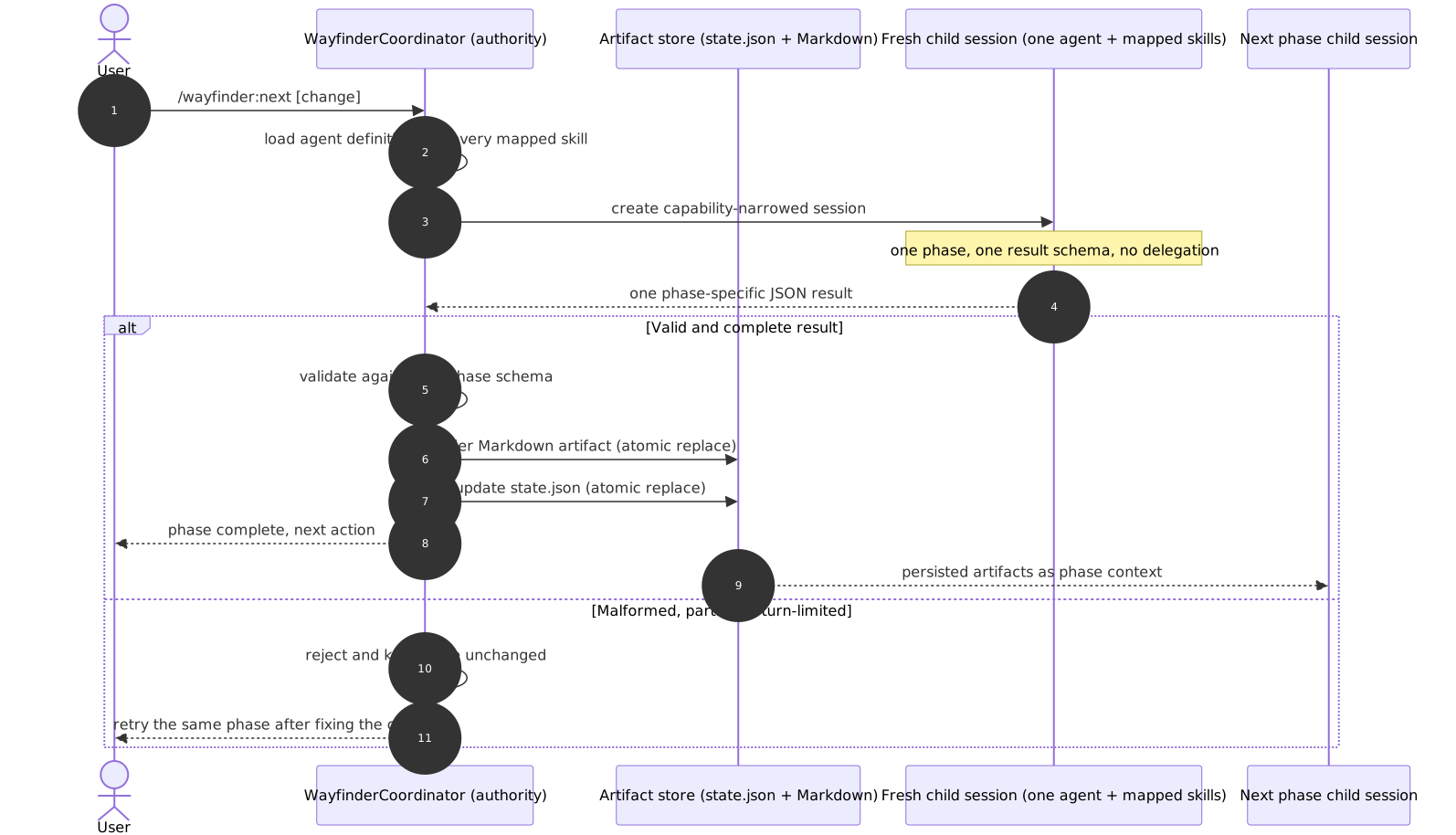
agent-communication.svg shows a single phase handoff: the coordinator loads one agent and its mapped skills, creates a capability-narrowed child session, validates the one JSON result, persists the Markdown artifact and state.json, and rejects malformed, partial, or turn-limited output without advancing state.
The Mermaid sources live in diagrams/wayfinder/ at the repository root and are rendered with pnpm diagrams. The SVGs are generated output; never edit them by hand.
Lifecycle and gates
intent -> discovery -> proposal -> proposal approval -> specification -> design
       -> plan -> plan approval -> one-unit implementation -> independent verification
       -> archive readiness -> archive
Advancement stops on critical questions, malformed or turn-limited output, incomplete plan or verification coverage, missing implementation paths/check evidence, unfinished units, failed verification, or incomplete archive inventory. Failed verification creates at most two resumable remediation units. Implementation reports are context only; the verifier must inspect current files and run focused commands independently. Wayfinder does not claim immutable Git provenance.
Passing verification no longer advances straight to archive: it exposes an explicit mutation-testing decision gate. There is no implicit skip. In an interactive UI the coordinator asks one concise question and persists the answer; headless use returns an actionable blocked status naming /wayfinder:mutate. Verification that passes without a recorded decision cannot reach archive.
Proposal and plan approval are explicit. In an interactive UI, next asks one concise confirmation. In headless use, it returns an actionable blocked status and requires approve; scope is never silently accepted. Plan approval additionally requires a recorded test-first decision for changes created by the current code; without it, the transition to implementation is blocked and /wayfinder:tdd is named. A change already past plan approval from an earlier version is grandfathered and is not retroactively gated (see the TDD section).
Mutation testing
Mutation testing is recommended, but the developer decides. The decision, mode, tool, stack, and reason are persisted per change and are immutable.
| Topic | Behavior |
|---|---|
| Decision gate | verify cannot advance to archive until /wayfinder:mutate run|skip -- is recorded |
skip | Verification passed → advance to archive. Verification pending → archive after it passes |
run | Instructs /wayfinder:verify, which runs the bounded mutation check |
| Tooling | Only tooling already present in the project; never installed, never added as a dependency |
| Unavailable | Persists unavailableReason and advances to archive without blocking |
| Survivors | Only non-equivalent survivors fail; an equivalent survivor needs a written justification |
| Failure | Creates one test-strengthening unit for the affected requirements and survivor files |
| Targeted recovery | Re-runs mutation over the prior scope, then re-verifies only the affected requirement ids |
| Budget | Mutation remediation is separate and bounded to two attempts, then stops for human reassessment |
Bounds: changed-scope cap 20 files, reported-survivor cap 50, child timeout 600000 ms, and the concurrency bound 2 applied only where the tool supports it. Survivor text is never interpolated into a command; the mutationist receives an argument list and never edits files.
Scope capability: some tools accept a bounded file scope, others can only mutate the whole repository. A bounded (--mode changed) decision never silently expands to whole-repo.
| Tool | Bounded scope | Concurrency bound |
|---|---|---|
| Stryker (JS/TS) | --mutate paths | applied (--concurrency 2) |
cargo-mutants (Rust) | --file paths | applied (--jobs 2) |
gremlins (Go) | positional package/path patterns | applied (--workers 2) |
go-mutesting (Go) | positional patterns | not applied |
mutmut (Python) | --paths-to-mutate | not applied |
cosmic-ray (Python) | whole repository only | not applied |
pitest (Java) | whole repository only | not applied |
For a whole-repository-only tool, a changed-mode run is refused rather than silently expanded; re-run with --mode full to allow it explicitly. The refusal is non-blocking: the reason is persisted and the change advances to archive.
Test-strengthening enforcement: a test-strengthening unit is accepted only when every reported changed path is a test path (test/, tests/, or __tests__/ segments, a bare test/tests/ spec/specs filename, or .test., .spec., _test., Test., Spec. filenames). A production edit is rejected and the unit stays pending.
This guardrail applies only to the paths the implementing child reports and uses a filename/directory heuristic, so a production file placed under a test-style directory or named *Test.*/*Spec.* can pass it. The independent verifier still inspects the workspace, so this is a guardrail, not a hard sandbox.
Detection uses the project's own manifests and lockfiles:
| Stack | Marker | Already-installed tools |
|---|---|---|
| JavaScript/TypeScript | package.json | Stryker (@stryker-mutator/* or local binary/config) |
| Rust | Cargo.toml | cargo-mutants |
| Python | pyproject.toml, setup.py, setup.cfg, requirements.txt, tox.ini | mutmut, cosmic-ray |
| Go | go.mod | gremlins, go-mutesting |
| Java | pom.xml, build.gradle, build.gradle.kts | pitest |
When nothing is detected, the coordinator recommends and continues without blocking.
Test-first (TDD)
TDD is recommended, but the developer decides. The decision is persisted per change, is immutable, and gates plan approval. There is no implicit default.
| Topic | Behavior |
|---|---|
| Gate position | Approving the plan cannot transition to implementation until /wayfinder:tdd strict|off -- is recorded |
| Recommendation | strict when the plan has non-exempt units; off only when every unit is exempt |
off | No test-first evidence is required for any unit |
strict | Non-exempt units must provide test-first evidence (see below) |
| Exemption | A unit marked tddExempt: true must carry a non-blank tddExemptReason (whitespace-only is rejected); exemptions are irrelevant when the decision is off |
| Grandfathering | A change already past plan approval without a decision predates this gate and is not retroactively gated; every change created by the current code must record a decision at plan approval |
| Immutability | A second /wayfinder:tdd call is rejected |
Under strict, an implementation result for a non-exempt unit is rejected (the unit stays pending and no state advances) unless it reports all of:
- at least one test path in
changedPaths; - a
testFirstobject with a failing run before the change and a passing run after; - the failing and passing runs referencing the same test scope (identical command).
The rejection message names the required scope and the next command. Mutation-generated test-strengthening units are already test-scoped, so they are exempt from the test-first evidence.
Enforcement is report-based and applies only to the paths and commands the implementing child returns, using a filename/directory heuristic: a production file placed under a test-style directory or named *Test.*/*Spec.* can pass, and a fabricated failing run is not independently detected. The independent verifier still inspects the workspace and runs focused checks, so this is a guardrail, not a sandbox.
Legacy grandfather policy: a change that reached implementation before this gate existed has no recorded decision and is intentionally neither blocked nor retroactively gated; it proceeds through implementation and verification without test-first enforcement. Every change created by the current code must record a decision at plan approval. This policy is pinned by a test so it cannot drift.
Test design and UI testability
Two methodological rule sets ship in the wayfinder-test-design skill, which the planner, implementer, and verifier load alongside their own skill:
- Test case design. Every functional scenario gets at least one happy-path (positive) test and one unhappy-path (negative, error, boundary, or valid-alternative) test, derived from requirements and use cases (functional black-box), combinable with white-box path coverage.
- UI testability. Query as a user would, in priority order: role/accessible name > label > placeholder > visible text/display value > alt/title >
data-testidlast. Name idsfeature-element-variant(login-email-input); follow the project's existing test attribute and id module; never anchor on implementation classes or deep DOM chains; keep ids out of business logic; accessibility comes first.
Evidence contract:
| Field | Where | Meaning |
|---|---|---|
requiresTests | plan unit | Planner marks units that must carry tests |
testDesign | implementation | { scenario, happy[], unhappy[] } per functional scenario |
testability | implementation | { testIds[], accessibleOnlyReason? }, required when the unit changes UI paths |
The coordinator rejects a unit, keeping it pending, when a requiresTests unit omits testDesign, when a scenario has no happy or no unhappy test, when scenario names are blank or duplicated, when a declaring unit reports no test file, or when a UI change omits testability, uses non-convention ids, or declares no ids without an accessibleOnlyReason.
UI detection is extension-based, but a UI-extension file that is a test path (for example src/App.test.tsx) is treated as a test, not a UI path; a unit touching both src/App.tsx and src/App.test.tsx still requires testability.
Enforcement is report-based and heuristic: a fragile selector, a missing negative test, or a misleading scenario name cannot be fully proven from the returned report. The independent verifier re-inspects the workspace and the tests, and remains the backstop.
Commands
| Command | Purpose |
|---|---|
/wayfinder:new -- | Create durable intent and state |
/wayfinder:status [name] | List changes, or show detailed progress and the next action when a name is provided |
/wayfinder:answer -- | Append clarification during discovery, proposal, or specification |
/wayfinder:next | Run exactly one analytical phase, or request a pending approval |
/wayfinder:approve | Record explicit approval |
/wayfinder:tdd -- | Record the immutable test-first decision before plan approval |
/wayfinder:mutate [--mode changed|full] -- | Record the immutable mutation-testing decision |
/wayfinder:build | Implement exactly one pending unit |
/wayfinder:verify | Independently verify every requirement exactly once |
/wayfinder:close | Validate readiness and move the change to archive |
Change names must contain 1–48 lowercase letters, digits, or hyphens and must start with a letter or digit.
Persistence and recovery
Active changes use:
.alisio/wayfinder/changes/<change>/
├── state.json
├── intent.md
├── clarifications.md       # when needed
├── discovery.md
├── proposal.md
├── specification.md
├── design.md
├── plan.md
├── progress.md
├── verification.md
├── verification-targeted.md   # after mutation remediation
├── mutation.md                # when a decision or run is recorded
└── archive-readiness.md
Closed changes move to .alisio/wayfinder/archive/YYYY-MM-DD-/ and no longer appear in the active change list. Individual files use temporary-file replacement with mode 0600. Archive uses a directory rename followed by a closed-state write with best-effort rollback if that write fails; it is not a crash-proof multi-operation transaction.
Do not edit these files while commands are running. Wayfinder does not currently lock a change against concurrent commands, so run only one Wayfinder command for a given change at a time.
Recovery rules:
- For malformed or turn-limited child output, retry the same phase after correcting the cause.
- For critical questions, run
answerand then retrynext. - Run
buildrepeatedly until every planned unit is complete. - Failed verification may create up to two resumable remediation units.
- After the remediation limit is exhausted, the change remains in verification and requires human reassessment rather than another automatic loop.
- Mutation testing requires an explicit
/wayfinder:mutatedecision before archive. - Non-equivalent survivors create a
test-strengtheningunit; strengthen tests only, never change production behavior to satisfy the tool. - Mutation remediation has its own budget of two attempts, separate from verification remediation.
Requirements and capability boundaries
| Requirement | Value |
|---|---|
| Node.js | >=22.16 |
| Minimum Alisio runtime | @alisio/alisio-code 0.1.0-alpha.17 or newer (carries @alisio/core 0.1.0-alpha.15) |
| Alisio SDK peer | >=0.1.0-alpha.10 <0.2.0 |
| Catalog category | methodology-harness |
| Runtime dependencies | Node.js built-ins and @alisio/sdk only |
Wayfinder declares the methodology-harness catalog category, so Alisio files it with the other methodology plugins instead of the model providers.
Category validation is strict. Alisio validates categories against a closed set, so a host that does not know methodology-harness rejects the plugin at load with a contract error rather than ignoring the unknown value. That value exists from @alisio/core 0.1.0-alpha.15 (and @alisio/sdk0.1.0-alpha.10) onward, so this release requires an Alisio host that carries core 0.1.0-alpha.15 or newer.
A plugin cannot express a host-version dependency: plugins depend on @alisio/sdk only, never on @alisio/core, so the host cannot enforce the minimum for you. Upgrade the CLI before installing:
npm install -g @alisio/alisio-code@0.1.0-alpha.17 # or: pnpm add -g / bun add -g@alisio/alisio-code 0.1.0-alpha.17 pins @alisio/core 0.1.0-alpha.15 and @alisio/sdk0.1.0-alpha.10; newer @alisio/alisio-code releases with core 0.1.0-alpha.15 or newer work too.
Child capabilities can only narrow the active parent session. The implementer needs parent write and process capabilities; the verifier and mutationist need process capability. Without them, those phases cannot complete.
Standalone behavior
The package imports only @alisio/sdk and Node built-ins; it never imports another plugin or @alisio/core. It registers ../.agents/agents and ../.agents/skills for inspection and future catalog interoperability. Current Alisio activation order can prevent newly registered external agents from appearing in the built-in subagents catalog. Wayfinder therefore treats direct api.sessions.create/run execution as primary and loads the same packaged resources itself.
Memory support is optional, fail-open, and read-only. If memory_search and memory_get survive Alisio's parent-capability intersection, a child may use privacy-safe high-level context. Memory is never lifecycle authority, required evidence, or a destination for source, secrets, prompts, personal data, or absolute paths.
External plugins execute inside the Alisio process with the user's privileges. Agent permissions, read-only profiles, and tool allowlists reduce model capabilities but are not an operating-system sandbox. Review the package before loading it.