
Architecture
Alisio is a pnpm monorepo with nine publishable packages. The OpenAI SDK adapter lives in @alisio/plugin-openai-compatible; core contains only provider contracts, the additive registry, activation and persistence.
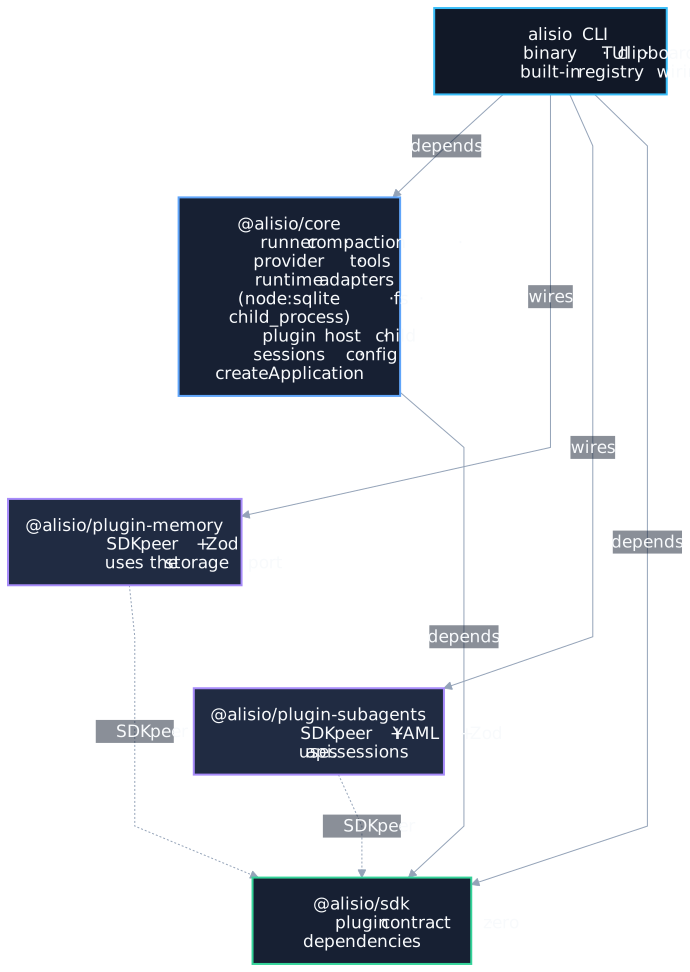
| Package | Role | Depends on |
|---|---|---|
@alisio/sdk | Public plugin contract: types plus definePlugin and textResult. No runtime or provider imports | Nothing |
@alisio/core | Provider-neutral runner, provider registry/activation/persistence, tools, runtime adapters, plugin host, child sessions, configuration and MCP | @alisio/sdk, MCP client, ajv, yaml, zod |
@alisio/plugin-openai-compatible | Built-in Chat Completions/Responses adapter and model discovery | @alisio/sdk (peer), openai |
@alisio/plugin-memory | Built-in persistent memory plugin | @alisio/sdk (peer), zod |
@alisio/plugin-subagents | Built-in subagents plugin: agent definitions, delegation tools, limits, git worktrees and the agent tree | @alisio/sdk (peer), yaml, zod |
alisio | CLI, TUI and built-in registry wiring the provider, memory and subagents plugins | @alisio/core, all built-in plugins, @alisio/sdk, @earendil-works/pi-tui, commander |
Dedicated model providers (DeepSeek, OpenCode Console (Zen), OpenCode Go) are @alisio/plugin-* packages published from the alisio-plugins monorepo and installed separately with alisio install npm:@alisio/plugin-....
Provider SDKs and runtime-specific imports stay out of the public SDK and the agent-core contracts.
Storage port
Plugins never import a SQLite driver. api.storage.sqlite(path) returns the SqlDatabase port defined in @alisio/sdk (exec, prepare, transaction, close), implemented by @alisio/core over node:sqlite with FTS5. The memory plugin is written only against this port, which is why it depends on nothing but the SDK and zod.
Built-in and external plugins
| Built-in | External | |
|---|---|---|
| Source | Registry in the CLI (packages/cli/src/builtin.ts) | --plugin, plugins config, global or trusted project plugin directories |
| Trust path | Host's trusted path, also under --read-only, without --trust-project | Explicit trust only; disabled by --read-only |
| Names | Unprefixed tools and commands | p_<hash>_ tool prefix, id:name commands |
internal effect | Allowed | Downgraded to external |
| Configuration | builtinPlugins.<id>; disabled with enabled: false or --disable-plugin <id> | Plugin-specific |
The core contains no references to memory: the CLI passes its registry to createApplication. Adding another built-in means appending an entry to that registry.
Child sessions
@alisio/core provides a generic child sessions service (packages/core/src/sessions/children.ts), exposed to plugins as api.sessions. A child session is a persisted conversation with a parent link that runs through the same runner with narrowed permissions: tools, capabilities and approvals are intersected with the parent's, a read-only parent makes the subtree read-only, and aborting a parent aborts its running descendants. On startup, children left running or queued are marked interrupted. The service contains no agent logic: definitions, limits, queues, git worktrees and the agent tree live in @alisio/plugin-subagents, and the TUI only renders generic panels (api.ui.panel) and read-only session views. See Child sessions.
Extension registry
@alisio/core keeps a typed extension registry in the plugin host (packages/core/src/extensions). Plugins register providers for the points declared in ExtensionPoints of @alisio/sdk (mascot, startup-screen). Resolution is deterministic and independent of plugin load order: highest priority, then plugin ID, then registration order within a plugin; ties at the winning priority are reported as extension_conflict diagnostics. renderStartup (packages/core/src/startup) resolves the providers, validates, sanitizes and clamps their output, and falls back to DefaultAlisioMascot and DefaultStartupScreen when a provider fails. The CLI (packages/cli/src/banner.ts) only decides when to show the screen and detects the terminal capabilities. See Extension points.
Runtime
Alisio runs on Node.js >= 22.16 or Bun >= 1.4.2. Both provide node:sqlite, which stores sessions (conversation, events, tool journal, plugin state, session lock) and memory. Node.js 22.16 is the minimum because earlier 22.x builds lack FTS5.
Run events
The runner reports progress as RunEvents: to onEvent embedders, to plugins (events.on) and as JSONL with alisio run --json. schemaVersion stays 1 while changes are additive, so consumers must ignore unknown fields and event types.
| Field | Meaning |
|---|---|
runId | One run of the agent loop. Embedders may preassign it (RunOptions.runId); otherwise a UUID |
seq | Per-run counter starting at 1; it restarts on every run |
eventId | Optional. The persisted global events.seq as a string, unique and increasing across runs. Absent for ephemeral events |
correlationId | Optional. Copied from RunOptions.correlationId (for example an HTTP request id) to every event of the run |
text_delta, reasoning_delta and tool_progress are ephemeral (EphemeralRunEventType): they stream to observers but are never stored, so they carry no eventId. Every other event is stored before observers see it. turn_completed adds durationMs (provider request to completed response) and ttftMs (time to the first streamed delta, absent when the provider streamed nothing). The run limit limits.timeoutMs counts active time: the runner keeps a pausable clock per run and every wait for a person (tool and external-directory approvals, ask_user_question, the plan review) pauses it through one registry, HumanWaits, that the runner, the plugin host's interactive UI and the external-directory approval share, so a host that binds a UI gets the behavior without extra code. A child session that waits for a person also pauses its ancestors; a parent that waits for a child does not pause. run_failed is additive for time limits: a run stopped by limits.timeoutMs or limits.firstTokenTimeoutMs ends as failed with code: "timeout" and a timeout object (kind, ms, model, provider, stage, tool, firstRequest, attempts); error is always a readable English sentence. When a model request stays silent until limits.firstTokenTimeoutMs the runner sends the same request again up to limits.firstTokenRetries times (default 1) and emits request_retry (attempt, of, reason: "first_token_timeout", afterMs); a retry is not a turn, appends nothing to the session and only happens while nothing was received for the request, so tool call IDs and the persisted session stay consistent. attempts counts the sends of the request that finally failed. The output-token budget of each request is resolved for the model of that request: an explicit limits.maxOutputTokens (or per-run value) wins, else the model catalog's maxOutputTokens capped at 65536, else 16384; response_truncated and the output_truncated failure carry the effective value and its source (user, model, default). A response cut off by the output-token budget before it is usable (finish reason length, that is a completed message with truncated: true, with no text and no tool call, or with a tool call whose arguments are not complete JSON; or a provider failure carrying code: "output_truncated", the typed OutputTruncatedError of @alisio/sdk, or the legacy text of older plugins) is recovered up to limits.truncationRecoveries times (default 2). The runner discards the cut calls (never executed, never persisted, so every stored tool call keeps its result), keeps visible text as a normal assistant message, emits truncation_recovery (attempt, of, reason: tool_call_cut or empty_response, maxOutputTokens, effort when lowered) and requests the same turn again with a transient continuation notice that is never stored; it is not a turn and does not touch maxTurns. When the recoveries are exhausted run_failed carries code: "output_truncated" and a truncation object (attempts, maxOutputTokens, model) with a readable message. Complete tool calls of a cut response still run, and a cut response with usable text and no calls completes with response_truncated. A user stop stays run_cancelled. RunEventDataMap and KnownRunEvent in @alisio/sdk type the payload of every event the core emits; tests/run-events-contract.test.ts checks the runner against them.
Decision Intelligence adds two stored, additive events: decision_completed (decisionId, pack?, provider, latencyMs, decisionCount, rejectedCount, confidenceMin) and decision_fallback (decisionId, pack?, provider, latencyMs, reason). They carry metadata only, never the state sent to the provider, and are not stored when decisions.telemetry is false. There is no decision_started event on purpose: the latency is in the final event.
Session database (v4)
SQLiteStore migrates forward only and additively: a database written by an older Alisio opens at schema version 4 without losing rows, and an older binary ignores the new tables and columns. Version 4 adds:
| Addition | Purpose |
|---|---|
runs table | One row per AgentRunner.run (id = RunEvent.runId): queued → running → completed, turns_exceeded, failed, cancelled or interrupted, with model, usage, times, error, owner process and an optional request_id unique per session |
workspaces table | Optional UI metadata (label, pin, last opened) |
blobs table | Metadata of content-addressed attachment bytes |
| New nullable columns | Session pin/archive, event created_at/correlation_id, tool call run_id/name/effect/started_at/ended_at |
The runner journals every run when the store implements the optional SessionStore methods (beginRun, endRun, runByRequest, runs, messagesPage, eventsPage, interruptRuns), so TUI and headless runs are recorded too; other SessionStore implementations keep working without them. Retrying beginRun with the same requestId in a session returns the existing run instead of creating one. At startup createApplication marks runs left queued/running by a dead process as interrupted, next to the existing reconciliation of child sessions. Root sessions now record createdAt/updatedAt.
Attachment blobs
BlobStore (app.blobs) keeps uploaded bytes under <state home>/blobs/sha256/<aa>/<hash> (directories 0700, files 0600, written atomically and deduplicated by SHA-256) and their metadata in the blobs table. Attachment.data is still required, so a blob never reaches the runner by reference: the host turns a BlobRef into a verified base64 image Attachment with blobs.attachment(ref) before runner.run. Messages therefore keep storing base64, exactly like inline attachments, which keep working unchanged.
Command catalog
CommandCatalog lists, resolves and runs slash commands for every surface. Its sources are the built-in commands (BUILTIN_COMMANDS), plugin commands, prompt templates and effective skills (skill:<id>); on a name collision the first source in that order wins. Each CommandDescriptor declares its surfaces (tui, web, api) and its execution: core commands (compact, model, effort, clear/new, sessions, resume, stats, tools, skills, plugins, mcp, agents and plugin commands) run through execute(name, args, { sessionId }); surface commands (help, connect, settings, copy, ask, exit, templates and skills) are handled by each UI. The TUI takes its command list and name resolution from the catalog and delegates /tools and /sessions to it; its output is unchanged.
Source resolution in development
Each package exports its built dist files, plus a development-only alisio-source export condition pointing at src/*.ts. The root tsconfig.json sets customConditions: ["alisio-source"] and pnpm dev runs Bun with --conditions=alisio-source, so workspace packages resolve to their TypeScript sources without a build. The condition is removed from the published exports through publishConfig.
Build and release
- Build:
pnpm buildrunstsc -p tsconfig.build.jsonin each package, emitting JavaScript and declarations todist. - Binary:
pnpm build:binarycompilespackages/cli/dist/main.jswithbun build --compile. - Versioning: changesets. The release workflow opens a version PR or publishes to npm with provenance.
- Binaries: after a publish, the release workflow cross-compiles standalone binaries with Bun (
linux-x64,linux-arm64,darwin-x64,darwin-arm64,windows-x64), writesSHA256SUMSand creates a GitHub Release (pre-release for pre-release versions). - Docs: this site is built with VitePress and deployed to GitHub Pages.